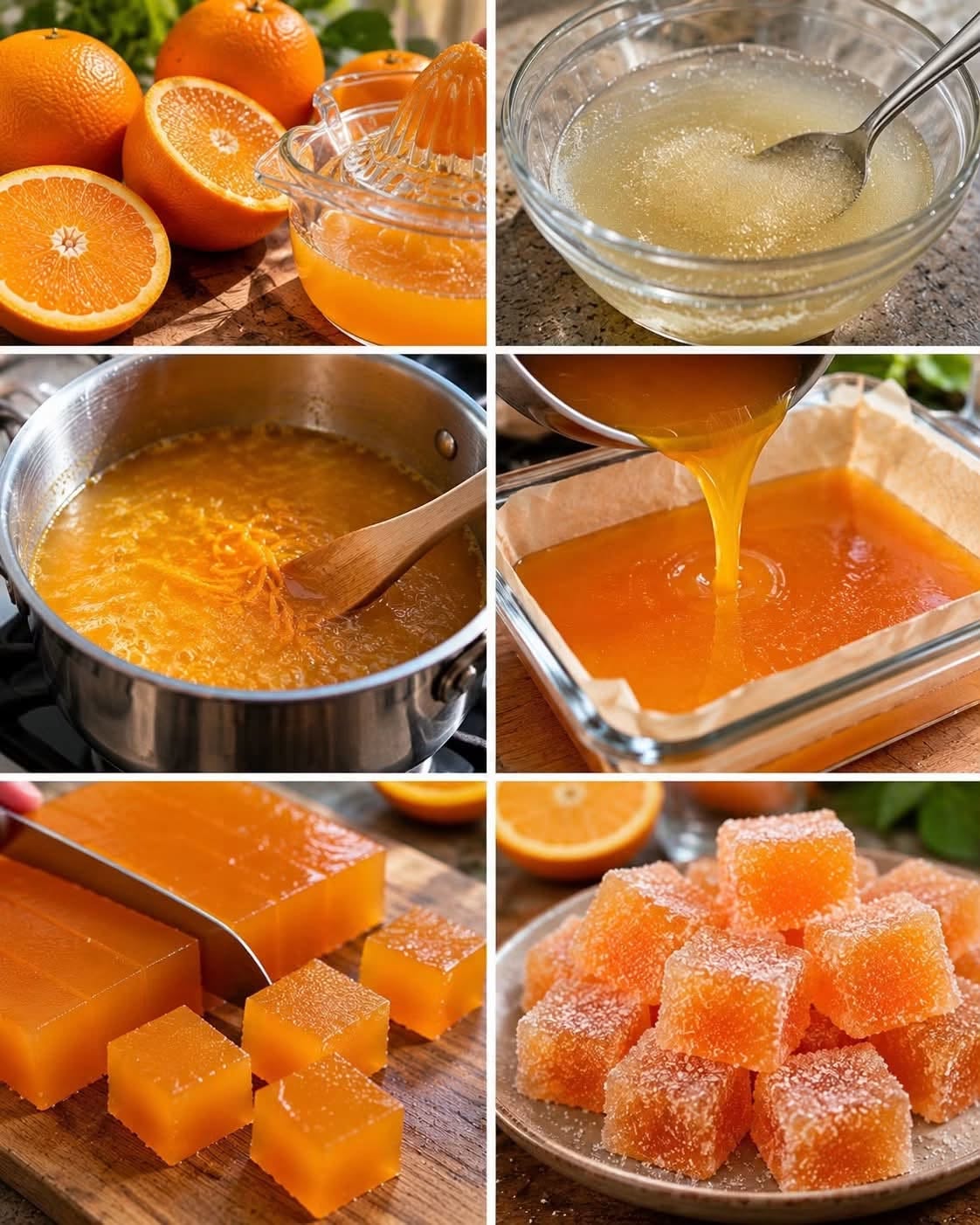
-
Prep Time: 20 minutes
-
Cook Time: 20 minutes
-
Setting/Cooling Time: 4 hours (or overnight for best results)
-
Total Time: 4 hours 40 minutes
-
Yield: 36 small candy squares (approx. 6 servings)
-
Difficulty/Intensity: Medium
Cooking Intensity Breakdown
-
Active Attention Level: High during boiling (requires continuous stirring to prevent scorching).
-
Heat Intensity: Medium to Medium-High (225∘F225^\circ\text{F} to 230∘F230^\circ\text{F} / 107∘C107^\circ\text{C} to 110∘C110^\circ\text{C} candy stage).
Equipment Needed
-
8×88 \times 8-inch square baking dish
-
Parchment paper
-
Medium heavy-bottomed saucepan
-
Candy thermometer (recommended)
-
Whisk and silicone spatula
-
Sharp chef’s knife
Ingredients
For the Jelly Candy Matrix
-
Fresh Orange Juice: 1121\frac{1}{2} cups (360 ml360\text{ ml}), strained (roughly 4–5 large navel oranges)
-
Fresh Lemon Juice: 2 tbsp (30 ml30\text{ ml}), strained (adds necessary acidity)
-
Orange Zest: 1 tbsp, finely grated
-
Granulated Sugar: 1121\frac{1}{2} cups (300 g300\text{ g})
-
Unflavored Gelatin Powder: 4 tbsp (approx. 4 envelopes or 28 g28\text{ g})
(Note: For a vegan alternative, substitute with 2122\frac{1}{2} tsp agar-agar powder).
-
Cold Water: 12\frac{1}{2} cup (120 ml120\text{ ml}) for blooming
-
Cornstarch or Liquid Glucose: 2 tbsp (prevents crystallization and adds chewiness)
-
Pinch of Salt: 18\frac{1}{8} tsp
For the Coating
-
Granulated Sugar: 12\frac{1}{2} cup (100 g100\text{ g}) for rolling
-
Cornstarch (optional): 1 tsp (mixed into coating sugar to keep candies dry)
Step-by-Step Instructions
Step 1: Prep the Pan and Bloom the Gelatin
-
Line an 8×88 \times 8-inch baking dish with parchment paper, leaving an overhang on two sides to easily lift the jelly out later. Lightly grease the parchment with non-stick cooking spray or neutral oil.
-
Pour 12\frac{1}{2} cup of cold water into a small bowl. Sprinkle the gelatin powder evenly over the water. Let it sit undisturbed for 5 to 10 minutes to “bloom” (absorb the water and soften).
Step 2: Prepare the Citrus Base
-
Wash your oranges and lemon thoroughly. Grate 1 tablespoon of fresh orange zest.
-
Squeeze the oranges and lemon, then run the juice through a fine-mesh sieve to remove all pulp and seeds. Measure out 1121\frac{1}{2} cups of clear orange juice and 2 tablespoons of lemon juice.
Step 3: Cook the Syrup
-
In a heavy-bottomed saucepan, combine the strained orange juice, lemon juice, orange zest, 1121\frac{1}{2} cups of granulated sugar, cornstarch (or glucose), and a pinch of salt.
-
Set the saucepan over medium heat. Whisk continuously until the sugar completely dissolves.
-
Bring the mixture to a steady simmer. Stir frequently to ensure the sugar does not burn at the bottom of the pan. Cook for approximately 8 to 10 minutes until the liquid reduces slightly and reaches a soft syrup stage (around 225∘F225^\circ\text{F} / 107∘C107^\circ\text{C} on a candy thermometer).
Step 4: Incorporate the Gelatin
-
Reduce the heat to low. Add the bloomed gelatin mass to the hot orange syrup.
-
Whisk briskly until the gelatin completely melts and integrates smoothly into the mixture.
-
Keep the pan over low heat for another 2 to 3 minutes, stirring constantly until the mixture turns clear, glossy, and slightly thickens. Do not let it boil vigorously once the gelatin is added.
Step 5: Pour and Set
-
Carefully pour the hot jelly mixture through a fine sieve into your prepared baking dish to catch any remaining zest bits or foam.
-
Skim off any air bubbles on the surface using a spoon for a smooth finish.
-
Allow the dish to sit at room temperature for 30 minutes, then transfer it uncovered to the refrigerator for at least 4 hours (or overnight) until firm and bouncy to the touch.
Step 6: Slice and Coat
-
Combine 12\frac{1}{2} cup of granulated sugar and 1 teaspoon of cornstarch in a wide, shallow bowl.
-
Run a butter knife around the unlined edges of the pan. Use the parchment paper overhang to lift the solid jelly block onto a clean cutting board.
-
Dust a sharp chef’s knife with powdered sugar or oil it lightly. Cut the jelly block into a 6×66 \times 6 grid to make 36 bite-sized squares.
-
Toss each square in the sugar mixture until fully coated on all sides.
Storage & Shelf Life
-
Room Temperature: Store coated candies in an airtight container lined with parchment paper at room temperature for up to 7 days. Keep them in a cool, dry place away from direct heat or humidity.
-
Refrigerated: Uncoated or coated candies keep well in an airtight container in the fridge for up to 3 weeks. If the sugar coating melts due to moisture, re-roll them in fresh sugar before serving.
Recipe Tips for Success
-
Continuous Stirring: Citrus syrups burn easily due to natural sugars. Use a silicone spatula to scrape the bottom corners of your saucepan throughout cooking.
-
Humidity Warning: High humidity can cause the sugar coating to turn sticky or weep. Coat the candies in sugar right before serving or store them with a small piece of parchment between layers.
-
Tartness Adjustment: If your oranges are particularly sweet, add an extra teaspoon of fresh lemon juice to balance the flavor profile.
Estimated Nutritional Information
Nutritional values are calculated per serving (approx. 6 candy squares).
