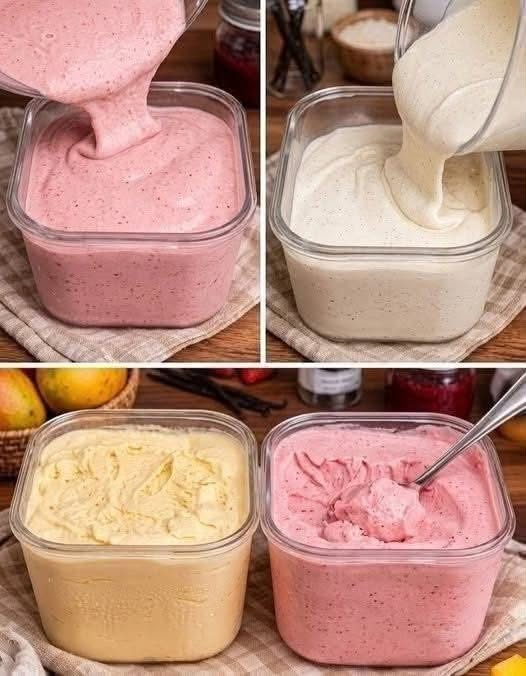
-
Prep Time: 25 minutes
-
Cook Time: 15 minutes
-
Chilling Time (Custard): 4 hours (or overnight for best results)
-
Churning Time: 20 to 25 minutes
-
Freezing/Hardening Time: 4 to 6 hours
-
Total Active Time: 40 minutes
-
Total Time to Serve: ~10 hours
-
Yield: 1 quart (approx. 8 servings)
🍦 Equipment & Cooking Intensity Breakdown
To achieve a bakery-quality texture, control over heat and timing is essential. Here is a breakdown of the process phases:
| Phase | Intensity Level | Key Technique | Temperature / Target |
| 1. Infusion | Low | Simmering milk, cream, and vanilla | Sub-simmer (~170°F / 77°C) |
| 2. Tempering | High (Requires attention) | Whisking warm liquid into yolks | Constant slow stream, continuous whisking |
| 3. Custard Thickening | Medium-High | Cooking custard until nappe stage | 175°F – 180°F (80°C – 82°C) |
| 4. Aging / Chilling | Low (Passive) | Rapid cooling & overnight aging | 35°F – 38°F (1.6°C – 3.3°C) |
| 5. Churning | Low (Machine) | Aeration & freezing base | Soft-serve consistency |
| 6. Hardening | Low (Passive) | Deep freezing for scoopability | 0°F (-18°C) |
🛒 Ingredients List
For the Custard Base:
-
1 1/2 cups (360ml) Heavy whipping cream (36% to 40% butterfat content)
-
1 1/2 cups (360ml) Whole milk (fresh, full-fat)
-
3/4 cup (150g) Fine granulated sugar
-
Pinch of fine sea salt (approx. 1/8 teaspoon)
-
1 whole vanilla bean (Madagascar or Tahitian), split lengthwise and seeds scraped (or 2 teaspoons premium vanilla bean paste)
-
5 large egg yolks (room temperature)
-
1 teaspoon Pure vanilla extract (added post-cooking for extra fragrance)
🥣 Step-by-Step Instructions
Step 1: Steep the Aromatics (Low Intensity)
-
Pour the heavy cream and whole milk into a medium heavy-bottomed saucepan.
-
Add half of the granulated sugar (approx. 6 tablespoons) and the salt to the saucepan.
-
Using the back of a paring knife, scrape the seeds out of the split vanilla bean pod. Add both the seeds and the empty pod into the cream mixture.
-
Set the saucepan over medium-low heat. Cook, stirring occasionally, until the sugar completely dissolves and tiny bubbles form around the edges of the pan (approx. 170°F). Do not let it boil.
-
Remove from heat, cover with a lid, and let steep for 20 minutes to infuse the vanilla flavor deeply into the dairy.
Step 2: Whisk the Yolks (Low-Medium Intensity)
-
While the milk mixture steeps, place the 5 egg yolks into a medium heat-proof bowl.
-
Add the remaining half of the granulated sugar.
-
Whisk vigorously for about 1 to 2 minutes until the yolks turn pale yellow, slightly thick, and fall in ribbons from the whisk.
Step 3: Temper the Yolks (High Intensity)
Tempering prevents the eggs from scrambling when mixed with hot liquid.
-
Reheat the milk-cream mixture briefly if it has cooled significantly until it is warm to the touch. Remove the vanilla pod with tongs.
-
Ladle out about 1/2 cup of the warm cream mixture.
-
While whisking the egg yolk mixture constantly with one hand, slowly drizzle the warm cream into the yolks in a thin, continuous stream.
-
Repeat with another 1/2 cup of warm cream to gradually raise the egg temperature.
Step 4: Cook the Custard Base (Medium-High Intensity)
-
Slowly pour the warm egg-cream mixture back into the main saucepan with the remaining cream, whisking constantly.
-
Place the saucepan over medium-low heat. Switch from a whisk to a heat-resistant rubber spatula.
-
Stir continuously, making sure to scrape the bottom and corners of the pan to prevent scorching.
-
Cook for 5 to 8 minutes until the custard thickens noticeably.
-
The Nappe Test: The custard is done when it coats the back of a spoon. Run your finger across the back of the spoon; if the line holds clear without running, it is ready.
-
Thermometer check: It should reach 175°F – 180°F (80°C – 82°C). Do not exceed 185°F, or the eggs will curdle.
-
Step 5: Strain, Cool, and Age (Low Intensity)
-
Immediately remove the pan from heat. Pour the custard through a fine-mesh strainer into a clean bowl to catch any unintended cooked egg bits.
-
Stir in the pure vanilla extract.
-
Prepare an ice bath: Fill a large bowl with ice water and place the bowl of custard inside it. Stir the custard occasionally for 10–15 minutes until it cools down to room temperature.
-
Cover the surface of the custard directly with plastic wrap to prevent a skin from forming.
-
Transfer to the refrigerator and chill for at least 4 hours, ideally 8 to 12 hours (overnight). Aging the base allows the fat to solidify slightly and the proteins to hydrate, resulting in a significantly creamier finish.
Step 6: Churning (Low Intensity)
-
Ensure your ice cream freezer bowl has been pre-frozen according to the manufacturer’s instructions (usually 12–24 hours at 0°F).
-
Pour the cold custard base into your ice cream maker.
-
Churn according to the manufacturer’s directions, usually around 20 to 25 minutes.
-
The ice cream is done when it reaches a thick, soft-serve consistency.
Step 7: Hardening & Storage (Low Intensity)
-
Transfer the soft-serve ice cream into a pre-chilled, airtight, shallow freezer-safe container (a metal loaf pan or insulated ice cream tub works great).
-
Press a piece of wax paper or parchment paper directly onto the surface to prevent ice crystals from forming.
-
Cover with a tight-fitting lid and freeze for at least 4 to 6 hours until firm enough to scoop.
👩🍳 Chef’s Tips for Success
-
Butterfat Matters: Use full-fat heavy whipping cream and whole milk. Skim or 2% milk contains too much water, which forms icy crunchiness instead of rich creaminess.
-
Don’t Rush Chilling: Skipping the overnight aging phase in the fridge will reduce flavor depth and impair the churned texture.
-
Adding Mix-ins: If you want to add chocolate chips, crushed cookies, or nuts, fold them in during the final 2 minutes of churning.
📊 Nutritional Information (Per Serving)
Servings per recipe: 8 | Serving size: 1/2 cup (approx. 100g)
| Nutrient | Amount per Serving | % Daily Value* |
| Calories | 280 kcal | — |
| Total Fat | 19 g | 24% |
| Saturated Fat | 11 g | 55% |
| Trans Fat | 0.5 g | — |
| Cholesterol | 155 mg | 52% |
| Sodium | 55 mg | 2% |
| Total Carbohydrates | 23 g | 8% |
| Dietary Fiber | 0 g | 0% |
| Total Sugars | 22 g | — |
| Added Sugars | 19 g | 38% |
| Protein | 4 g | 8% |
| Vitamin D | 0.8 mcg | 4% |
| Calcium | 95 mg | 8% |
| Iron | 0.4 mg | 2% |
| Potassium | 110 mg | 2% |
