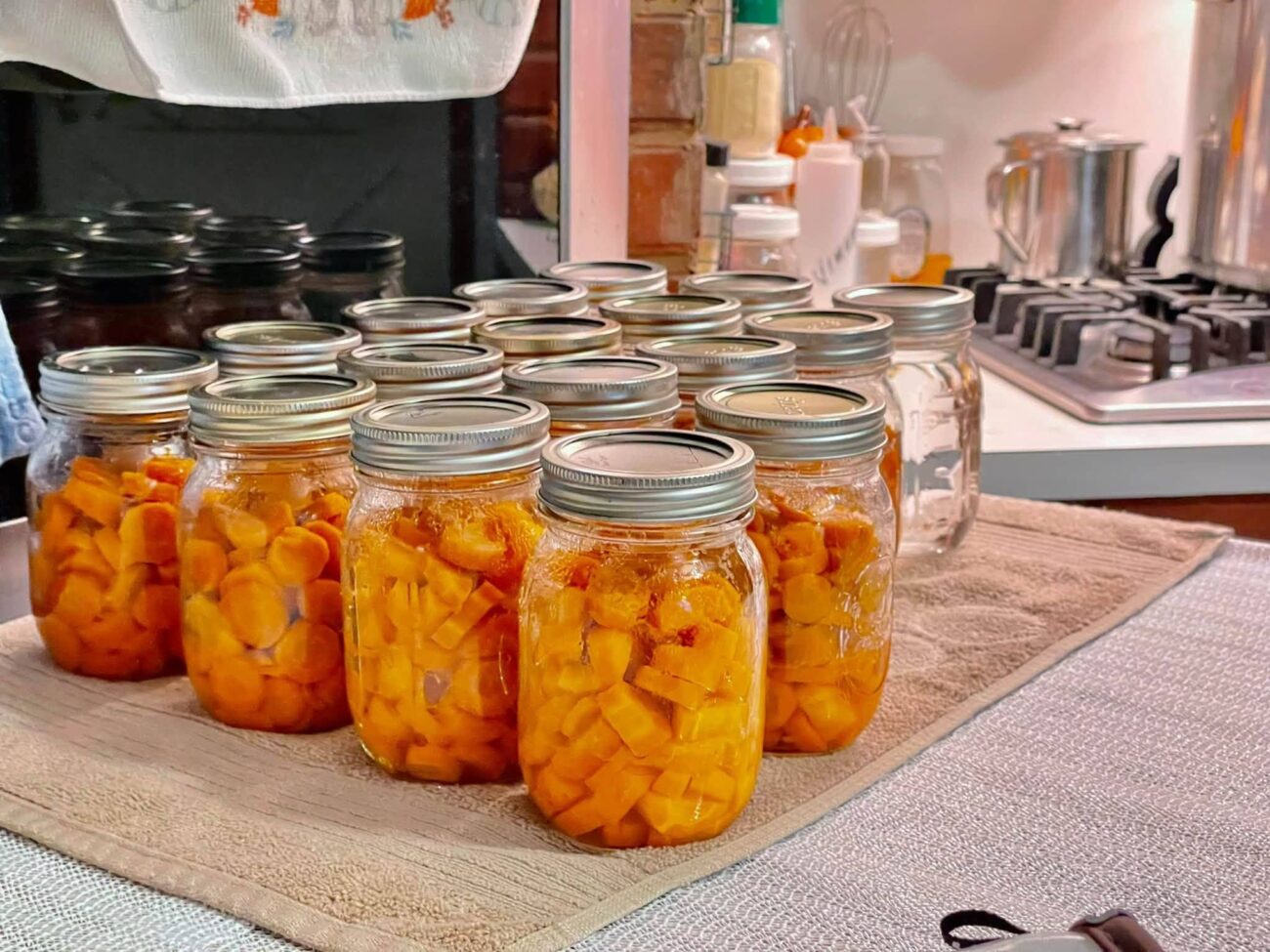
| Metric | Details |
| Prep Time | 25 minutes |
| Active Cooking / Venting Time | 20 minutes |
| Pressure Processing Time | 25 minutes (Pints) / 30 minutes (Quarts) |
| Natural Cooling / Depressurization | 45 to 60 minutes |
| Total Time | ~2 hours |
| Heat Intensities Required | High (to reach boil/steam), Medium-High (to build pressure), Low-Medium (to maintain steady pressure) |
| Difficulty / Skill Intensity | Moderate (Requires strict adherence to pressure canning safety) |
| Yield | 4 Quart Jars or 8 Pint Jars |
Equipment Needed
-
Pressure Canner (Dial-gauge or weighted-gauge; do not use an electric multicooker/Instant Pot)
-
Canning Jars: 4 quart-sized (32 oz) or 8 pint-sized (16 oz) glass mason jars, inspected for nicks or cracks
-
Lids & Bands: New two-piece vacuum-seal lids and clean metal screw bands
-
Canning Funnel & Jar Lifter
-
Vegetable Peeler, Chef’s Knife, and Cutting Board
-
Clean Damp Cloth (for wiping jar rims)
Ingredients
-
6 to 7 pounds (approx. 3 kg) fresh carrots (medium-sized, firm, crisp, and free of blemishes; slender young carrots yield the best texture)
-
4 teaspoons canning or pickling salt (1 teaspoon per quart jar, or ½ teaspoon per pint jar — optional, used strictly for flavor; avoid iodized table salt as it can cloud the liquid)
-
½ to 1 cup filtered water (just 2 tablespoons per pint jar or ¼ cup per quart jar to generate initial steam)
Step-by-Step Instructions
Phase 1: Preparation & Jar Sanitation
-
Inspect and warm the jars: Wash your mason jars, lids, and bands in hot, soapy water and rinse thoroughly. Place the empty jars inside your pressure canner with 2 to 3 inches of water at the bottom. Set the burner to Low heat to keep the jars hot until you are ready to pack them; this prevents thermal shock and glass breakage.
-
Prep the carrots: Scrub the carrots thoroughly under cold running water to remove all soil. Trim off the green tops and root tips. Peel the carrots completely—leaving the skin on increases the risk of microbial contamination and can impart a bitter flavor after high-heat processing.
-
Slice uniformly: Cut the peeled carrots into uniform slices (about ¼-inch to ½-inch thick coins) or strips (batons). Uniform sizing ensures even heat penetration during pressure processing so smaller pieces do not turn mushy while thicker chunks remain undercooked.
Phase 2: Dry-Packing the Jars
-
Pack tightly: Remove one hot jar at a time from the canner. Pack the raw carrot slices tightly into the hot jar, shaking the jar gently on a folded kitchen towel to settle the pieces and eliminate large air pockets. Stop packing when you reach 1 inch below the top rim (1-inch headspace).
-
Add salt and minimal liquid: Add 1 teaspoon of canning salt per quart jar (or ½ teaspoon per pint jar), if using. Pour ¼ cup of boiling water into each quart jar (or 2 tablespoons into each pint jar). Unlike traditional canning, the carrots will sit above this small pool of water; the superheated steam generated inside the sealed jar will cook and preserve them without waterlogging the vegetable fibers.
-
Wipe and seal: Dip a clean paper towel or lint-free cloth into hot water or white vinegar and wipe the glass rim of each jar carefully to remove any stray carrot bits or salt crystals. Center a new flat lid on each jar and screw on the metal band until it is fingertip-tight (snug, not forcefully cranked down, so trapped air can escape during processing).
Phase 3: Heat Intensities & Pressure Processing
-
Lock and vent (High Heat): Ensure your pressure canner has 2 to 3 inches of simmering water in the base. Place the filled jars on the rack inside the canner, leaving space between them for steam circulation. Lock the canner lid securely, leaving the vent pipe (petcock) open. Turn the stove burner to High heat.
-
Exhaust the air (10 Minutes): Once a steady, visible funnel of steam begins escaping from the open vent pipe, set a timer for 10 minutes. Maintain High heat during this entire venting phase. Exhausting trapped air is mandatory so the interior reaches pure steam temperature rather than a cooler air-steam mixture.
-
Pressurize (Medium-High Heat): After 10 minutes of steady venting, place the weighted gauge over the vent pipe (or close the petcock on a dial-gauge canner). Reduce the burner slightly to Medium-High heat and watch your gauge closely until it reaches the target pressure for your altitude:
-
Weighted-Gauge Canner: 10 PSI (at 0–1,000 ft elevation) or 15 PSI (above 1,000 ft elevation).
-
Dial-Gauge Canner: 11 PSI (at 0–2,000 ft), 12 PSI (2,001–4,000 ft), 13 PSI (4,001–6,000 ft), or 14 PSI (6,001–8,000 ft).
-
-
Process at steady pressure (Low-Medium Heat): Once the target PSI is reached, immediately lower the burner to Low-Medium heat—just enough to keep the weight gently jiggling (1 to 4 times per minute) or the dial needle steady at your exact target PSI. Start your processing timer:
-
Pint Jars: 25 minutes
-
Quart Jars: 30 minutes(Note: If the pressure ever drops below the target PSI, bring the burner back up to pressure and restart the full 25- or 30-minute timer from zero.)
-
Phase 4: Cooling & Storage
-
Natural depressurization (Heat Off): When the timer finishes, turn off the burner completely. Do not move the canner, do not place a cold wet towel over it, and never remove the weight or open the lid early. Allow the pressure to drop naturally to 0 PSI (roughly 45 to 60 minutes).
-
Cool and check seals: Wait an additional 10 minutes after the gauge hits zero, unlatch the lid away from your face, and use a jar lifter to transfer the jars onto a thick towel-lined counter, leaving 1 to 2 inches of space between jars. Let them sit undisturbed for 12 to 24 hours. Press the center of each lid; if it does not flex up and down, the vacuum seal is secure. Remove the metal rings, wipe the jars clean, label them with the date, and store in a cool, dark pantry.
Shelf Life & How Long They Last
-
Unopened (Pantry Storage): Properly vacuum-sealed dry-packed carrots remain safe to eat indefinitely as long as the seal stays intact and the jar is free of rust or cracks. For optimal flavor, texture, and vitamin retention, consume within 12 to 18 months.
-
Storage Conditions: Store in a cool, dark, dry cabinet or cellar between 50°F and 70°F (10°C–21°C). Avoid direct sunlight (which fades the beta-carotene pigment) and freezing temperatures (which can break the glass or pop the seal).
-
Opened (Refrigerated): Once a jar is opened, transfer any unused carrots and their natural liquid to a covered container and refrigerate at or below 40°F (4°C). Consume within 3 to 4 days.
-
Unsealed Jars: If a jar fails to seal within 24 hours, refrigerate it immediately and use within 3 days, or freeze the contents in a freezer-safe container for up to 8 months.
Nutritional Information
Values are approximate per 1-cup serving (approx. 128g) of drained dry-packed carrots prepared without added salt. If prepared with 1 teaspoon of canning salt per quart, sodium increases by approximately 575 mg per cup.
| Nutrient | Amount per 1 Cup (128g) | % Daily Value* |
| Calories | 52 kcal | 3% |
| Total Fat | 0.3 g | 0% |
| Saturated Fat | 0.0 g | 0% |
| Cholesterol | 0 mg | 0% |
| Sodium (unsalted) | 88 mg | 4% |
| Total Carbohydrates | 12.3 g | 4% |
| Dietary Fiber | 3.6 g | 13% |
| Total Sugars | 6.1 g | — |
| Protein | 1.2 g | 2% |
| Vitamin A (as Beta-Carotene) | 1,069 mcg RAE | 119% |
| Vitamin K | 16.9 mcg | 14% |
| Potassium | 410 mg | 9% |
| Vitamin C | 7.6 mg | 8% |
