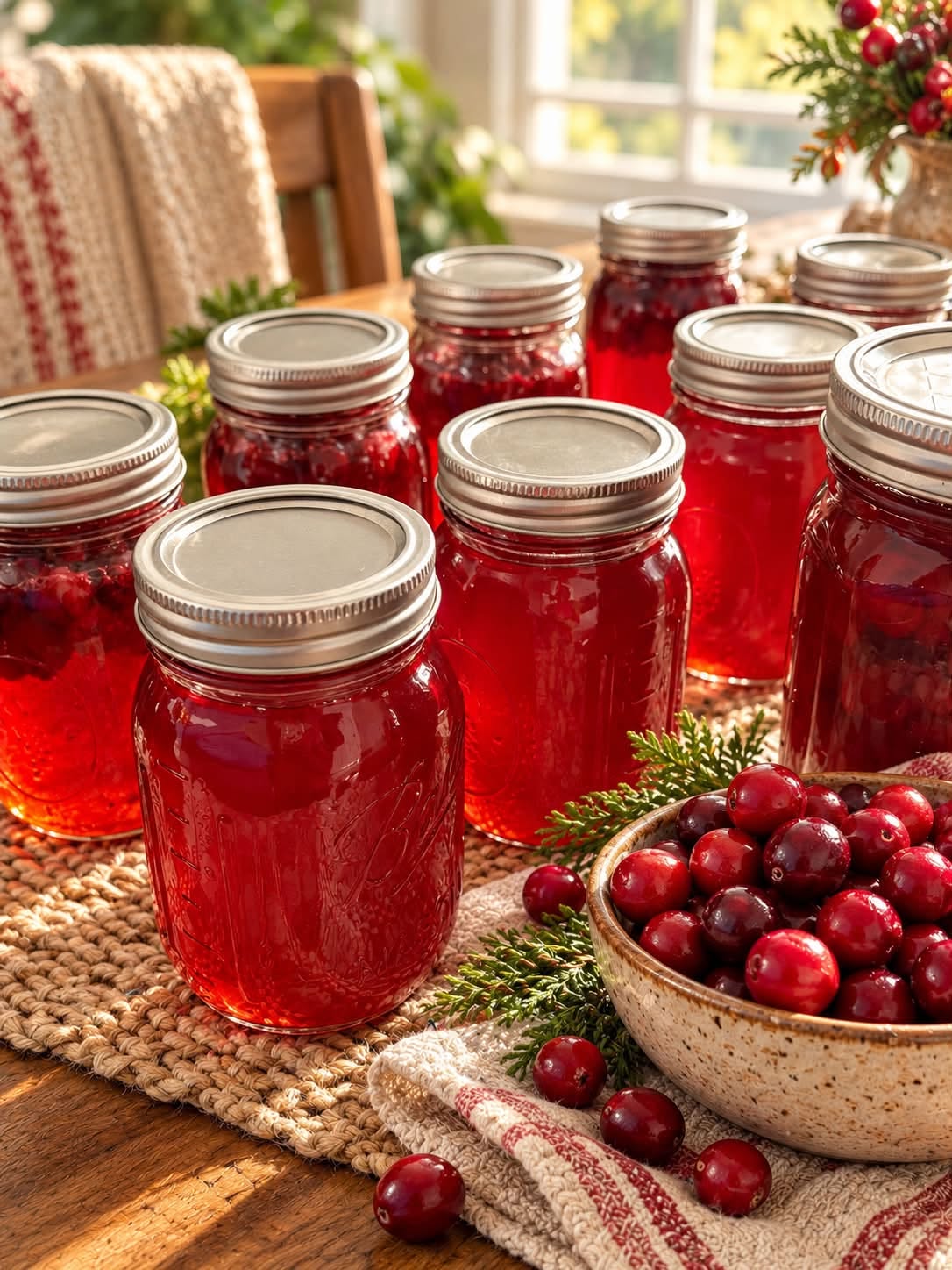
-
Prep Time: 20 minutes
-
Cook & Infusion Time: 25 minutes
-
Water Bath Processing Time: 15 minutes (for pints or quarts at 0–1,000 feet elevation)
-
Cooling & Sealing Time: 12 to 24 hours
-
Total Active Time: 60 minutes
-
Difficulty Level: Beginner-Friendly
-
Yield: Approximately 4 quarts (or 8 pints)
-
Shelf Life: 12 to 18 months in a cool, dark pantry
Heat Intensity Guide
-
Initial Boil (Stovetop): High heat to bring water and cranberries to a rapid boil, then reduced to Medium-Low for a gentle simmer.
-
Canning Bath (Water Canner): High heat to reach a full, rolling boil, then adjusted to Medium-High to maintain a steady, vigorous boil throughout the entire 15-minute processing window.
Ingredients
-
12 cups fresh or frozen cranberries (about 3 pounds / 1.36 kg), rinsed and sorted with soft or bruised berries removed
-
16 cups filtered water (4 quarts / 3.8 liters), divided
-
2 to 3 cups granulated white sugar (400g to 600g), optional—adjust to taste depending on whether you prefer tart or lightly sweetened juice
-
2 tablespoons bottled lemon juice (optional, enhances color stability and adds brightness; fresh cranberries are already safely below pH 4.6)
Equipment Needed
-
Large 8-quart to 12-quart stainless steel stockpot
-
Boiling water bath canner with a canning rack
-
4 quart-sized (or 8 pint-sized) glass Mason jars
-
New two-piece canning lids and bands
-
Fine-mesh sieve, jelly bag, or several layers of cheesecloth
-
Jar funnel, bubble remover, and jar lifter
Step-by-Step Instructions
1. Prepare Your Canning Station and Jars
Wash your Mason jars, lids, and bands in hot, soapy water and rinse thoroughly. Place the empty jars into your boiling water bath canner, fill the canner with enough water to cover the jars by at least 1 to 2 inches, and set the burner to Medium-High heat. Keeping the jars simmering in hot water prevents thermal shock when you pour hot juice into them later.
2. Burst the Cranberries
Combine the 12 cups of rinsed cranberries and 8 cups of the filtered water in your large stainless steel stockpot. Place the pot over High heat and bring the mixture to a full boil, stirring occasionally. Once boiling, reduce the burner to Medium-Low heat and simmer gently for 10 to 15 minutes. During this time, the cranberry skins will pop and burst, releasing their rich juice and natural pectin. Avoid mashing the berries aggressively if you want crystal-clear juice, as crushing the pulp releases starches that can make the final juice cloudy.
3. Strain the Juice
Remove the stockpot from the heat. Set a large fine-mesh strainer lined with damp cheesecloth or a damp jelly bag over a clean, heatproof bowl or second large pot. Ladle the hot cranberries and liquid into the strainer. Let the juice drip naturally for 15 to 20 minutes. If you want maximum yield and don’t mind a slightly fuller body, gently press the cooked berries with the back of a wooden spoon, though squeezing too hard will extract excess pulp.
4. Sweeten and Reheat the Juice
Pour the strained cranberry juice back into a clean stockpot and stir in the remaining 8 cups of filtered water. If you are using granulated sugar, add 2 to 3 cups now, along with the optional lemon juice. Place the pot back over Medium-High heat, stirring constantly until the sugar completely dissolves and the juice comes to a brisk boil. Boil for 2 minutes, skimming off any pink foam that rises to the surface with a slotted spoon.
5. Fill the Hot Jars
Use your jar lifter to remove one hot jar at a time from the water bath canner, emptying the hot water back into the canner. Set the jar on a thick kitchen towel. Place your canning funnel in the jar and ladle the boiling cranberry juice into the jar, leaving 1/4-inch headspace from the top rim. Wipe the rim clean with a damp paper towel to remove any sticky sugar residue, center a flat lid on the jar, and screw on the metal band until it is fingertip-tight.
6. Process in the Boiling Water Bath
Lower the filled jars back onto the rack inside the boiling water bath canner, ensuring the water covers the tops of the jars by at least 1 inch. Cover the canner with its lid and turn the heat to High until the water returns to a vigorous, rolling boil. Once boiling, lower the heat slightly to Medium-High so the water stays at a steady boil without boiling over, and set a timer for 15 minutes. (Note: If you live above 1,000 feet in elevation, increase the processing time by 5 minutes for every 1,000 to 3,000 feet of altitude).
7. Cool, Check Seals, and Store
Turn off the heat, remove the canner lid, and let the jars sit in the hot water for 5 minutes to acclimate. Using your jar lifter, lift the jars straight up and place them undisturbed on a towel-lined counter, leaving at least 1 inch of space between each jar. Leave them to cool completely for 12 to 24 hours. You will hear distinct “ping” sounds as the vacuum seals form. Press the center of each lid after 24 hours; if it does not flex up and down, the jar is properly sealed.
Shelf Life and Storage Tips
-
Unopened Jars: Properly sealed jars stored in a cool, dark, and dry pantry (between 50°F and 70°F) will remain at peak flavor, color, and nutritional quality for 12 to 18 months. Always remove the metal screw bands before storing so moisture does not get trapped and cause rust.
-
Opened Jars: Once a jar is opened, store it in the refrigerator and consume the juice within 7 to 10 days.
-
Unsealed Jars: If any lid fails to seal after 24 hours, place that jar immediately into the refrigerator and enjoy it within a week, or reprocess it with a brand-new lid within 24 hours.
Nutritional Information
The following nutritional values are estimated per 1 cup (8 fl oz / 240 ml) serving, based on a batch made with 2 cups of granulated sugar divided across 16 total cups of finished juice:
| Nutrient | Amount per 1 Cup Serving | % Daily Value* |
| Calories | 115 kcal | 6% |
| Total Fat | 0.1 g | 0% |
| Saturated Fat | 0 g | 0% |
| Cholesterol | 0 mg | 0% |
| Sodium | 5 mg | 0% |
| Total Carbohydrates | 29 g | 11% |
| Dietary Fiber | 0.5 g | 2% |
| Total Sugars | 26 g | — |
| Protein | 0.3 g | 1% |
| Vitamin C | 14 mg | 16% |
| Manganese | 0.2 mg | 9% |
